We left a sunny warm England behind, glad to be distancing ourselves from the unbelievable chaotic political events our new Prime Minister Boris Johnson is conjuring on a daily basis. We arrived in a hot Greece to find Déjà vu where we had left her, under wraps in the boatyard.
With three days before our planned launch we set about the jobs, cleaning and stowing the vast cover that had encapsulated her for 6 hot and dusty weeks and then polishing the hull which we had failed to do at the beginning of the season. There is no doubt the polish provides essential protection against sun damage, so were keen to get it on. We were grateful for an excellent staging to give us easy access so the task was accomplished with little fuss.
Once launched we went round into the inland sea and spent a couple of nights at the anchorage in Vonitsa before returning to the quay in Preveza to meet Max and Celia who were joining us for 8 days in the Ionian.
At anchor near VonitsaWelcome Celiaand Welcome Max
We were blessed with a settled week ahead and we were able to show Max and Celia a little of what Greece has to offer sailors in the Ionian. From Preveza we sailed down to Vliho Bay, had a BBQ and stayed overnight admiring the jellyfish that have invaded the bay. We think that they are an invasive species called the Upside Down Jellyfish which is a native of the swamps in the Caribbean. From there we visited Vathi on Ithaca, Efemia on Kefalonia, Sivota on Lefkas, Little Vathi on Meganissey, Kalamos for a couple of windy days before heading up to Lefkas Marina in time for their departure.
Can anyone identify this species of jellyfish found in Vliho Bay Lefkada?Captain Nigel
Max and Celia were fantastic company, Max relishing the sailing and helping us out by going part way up the mast to retrieve a halyard. Celia was brilliant and coped with all the seafaring stuff wearing a large smile most of the time. The large number of cats roaming the Greek streets and restaurants possibly presented more of a challenge!
The story of their visit is best told in pictures!
A beer on KefaloniaView across Efimia KefaloniaMax and Celia in Little Vathi on MeganisseyMemory of Little VathiTypical waterside eatingCelia at seaMax in charge, or is it George?Big Vathi on IthacaMax up the mast on windy KalamosWalk to beach alongside at KalamosMoonrise at Kalamos, before the wind cameUnderway home, great to sail with you both
We rented a car and collected our young visitors, Thomas and Ben, from the airport near Argostoli on Kefalonia and this gave us the chance to visit the island’s south and south west coast as well as traversing the huge mountain range that forms the backbone of the island. It was a good trip and we enjoyed swimming off a south coast beach, which made a change from swimming off the boat!
Lunch under the castle near the airport. It was very hot and the car aircon wonderful!
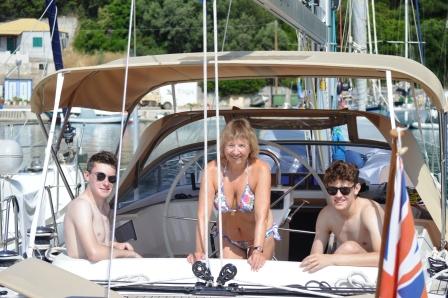
A post exam holiday for Thomas and Ben, our (great) nephews, the week beginning 5th July was to be one of the hottest. Daily temperatures ranged from 30-35 degrees C and for the first five days there was little wind, just light afternoon sea breezes to bring some mild relief. The only solution was to hit the water, regularly, and this set the pattern for Thomas and Ben’s holiday.
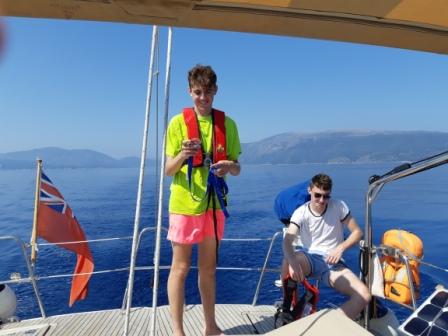
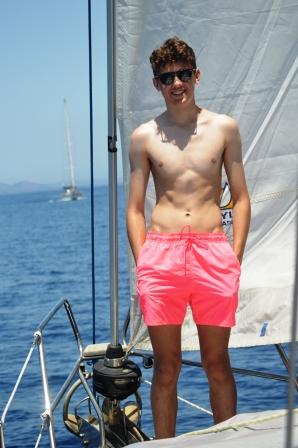
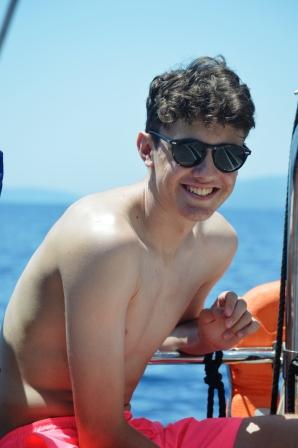
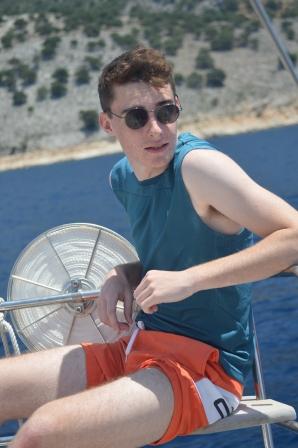
Efimia, Kefalonia where we startedOn board Deja VuSafety briefing on day oneCool crew
From Kefalonia we visited the islands of Ithaca, Kalymnos, Meganissi and finally Lefkas, stopping also on the mainland coast at Palairos and Kefali.
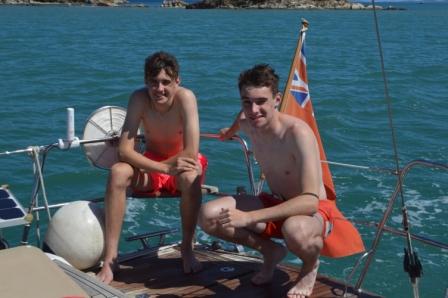
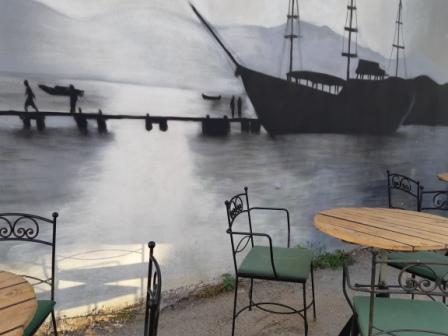
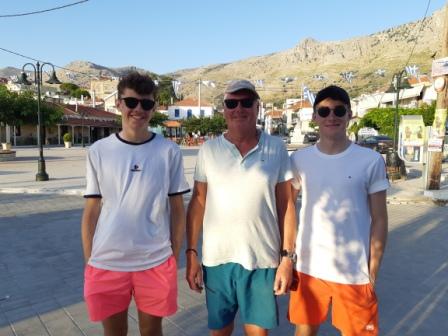
Brothers at seaWall art in Palairos- it caught the imagination!The guys in Palairos
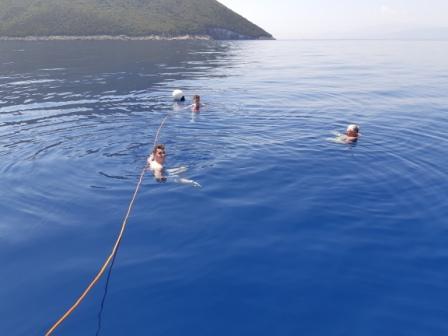
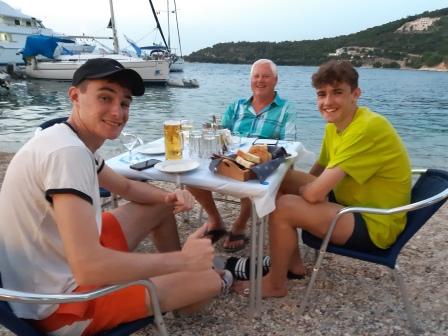
We stopped regularly in a variety of superb anchorages where the water was crystal clear and a beautiful blue. Swimming was fantastic and lots of fun. It was very busy everywhere but we managed to overnight in small village ports or stayed on anchor in a bay. We enjoyed some meals ashore and some cooked on board.
One of the anchoragesA swim en route in the deep blueIntro to snorkellingBenThomasSynchronised jumping inNot a lot to do on this passageThe sails did come out!
Thomas and Ben enjoyed our stay at Spartakahori, courtesy of Greek host Babis, as they had the opportunity to climb to the village high up on the cliff and have a drink overlooking the Ionian inland sea.
Dinner chez Babis
Wednesday 10th July started with little wind so we dropped them off in Nidri for a fix of town crawling before they rejoined us in Vliho Bay where we had anchored in a freshening wind.
We were well anchored but not so for another boat. Picture the scene. It was 8pm, Mo was taking a shower down below, Nigel and Ben were preparing food for supper in the galley, Thomas was in the cockpit reading. There was an almighty crash and another boat had dragged its anchor, wrapping itself around our bow. All hands to the scene and we managed to prise him away and then we looked at the damage. We sustained mostly superficial gel coat scrapes and scratches, he was worse off. Nigel went to help him re-anchor and exchange details for an insurance claim!
Indeed we had a storm that night with plenty of lightning and wind. Thomas and Ben were a little non-plussed to have their phones placed firmly in the oven, our on board Faraday’s cage! Needless to say a sleepless night ensued for Mo and Nigel as they managed an anchor watch, fearful for a repeat performance of dragging anchors. At 3 am there were three boats circling the bay trying to re-anchor, fortunately we stayed firmly put thanks to Mr. Manson (our anchor).
It was properly windy on Thursday and finally Thomas and Ben enjoyed a proper sail. We did reef the main and the jib as we were on a beat, but still managed over 7 knots as they took it in turns to do the helming and the winching. All of a sudden sailing wasn’t all loafing around sunning yourself, it’s quite hard work!
Captain ThomasProper crewing at last!Even Ben had a go at winching and discovered it was hard work!
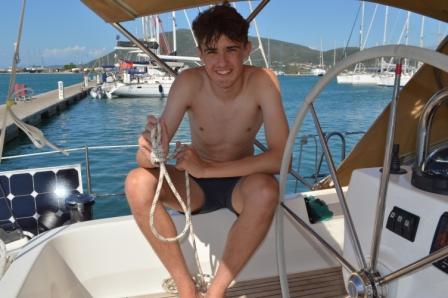
We ended up in Lefkas Marina and were treated to a lovely Greek meal in the town before Thomas and Ben headed off for the airport on Friday. We had a great time with them and the week together gave us a good opportunity to get to know them both better. They acqitted themselves well and passed out with beginner’s crewing skills. Ben had taken a keen interest in knot tying, but he did have a favourite that he excelled at.
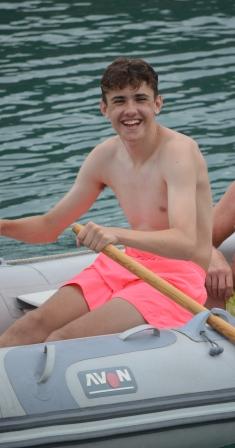
Ben’s accomplished knotRowing in Vliho Bay
We sailed north in a very bumpy sea but had a great reach, cracking 8 knots. We now have a few days ahead to clean up, lift out, cover up and get ready for our return home Wednesday 17th July.
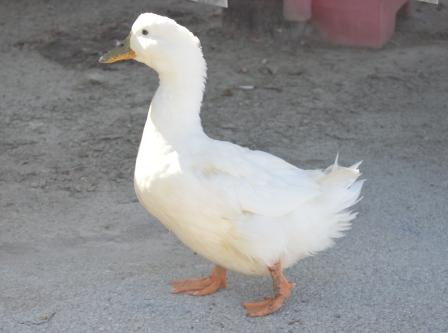
Although there had been times when we had felt captive in Kalamata, when the time came to leave we realized we had grown to be quite fond of the place, especially the duck that lived beside the quay we had made our home. The sheer fun of watching him and his mate chase the cats away was worth tolerating the noise they made.
The resident duck
We left early morning on Saturday 22nd June bidding a wistful farewell to the stunning mountain backdrop that had framed Déjà Vu’s home for the past year. One thing we had learned was that the south western Peloponnese is a windy place and our familiar trip round to Methoni and Pilos was once again a testament to that knowledge. We chose not to beat 15 miles into the strong headwind that greeted us and we ploughed through the rough sea on the engine. We took the weather window of light southerlies that emerged on Monday to make the long trip north to Katakolon, close to the northern tip of the western Peleponnese. This time we had too little wind and were denied even the cruising chute to make sufficient progress in a very uncomfortable and rolly beam sea.
Travelling north
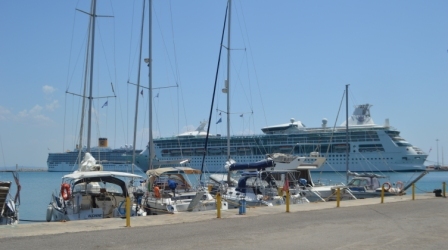
Katakolon was a welcome refuge from the sea and we tied up on the north visitor’s quay under three towering cruise ships docked to enable passengers the opportunity of visiting the ancient site of Olympia. Fortunately the huge, noisy vessels had gone by 6pm and we walked ashore to explore, in peace, the pretty village bursting with cafes and souvenir shops.
Quay at KatakolonKatakolon village front
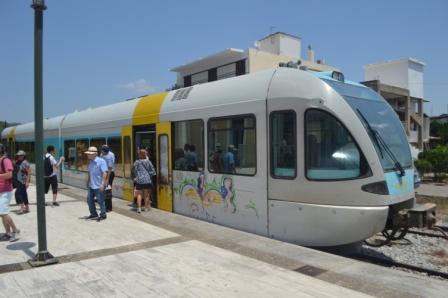
It was easy to catch the early morning train just next to the quay and after a very pleasant 40 minutes of chugging through the agricultural hinterland, whistling at all the road crossings, we arrived in the busy tourist town of Olympia.
Train to Olympia
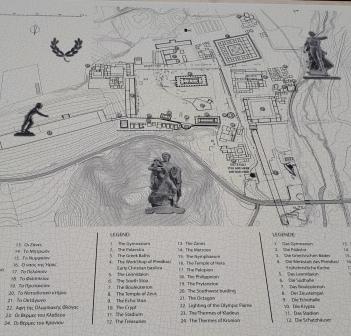
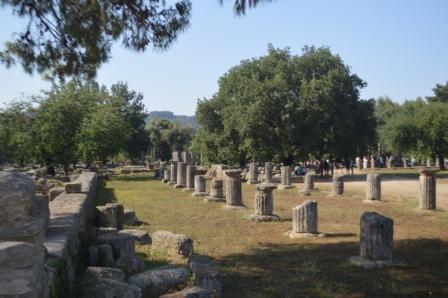
Cafes, taxis, coaches, people everywhere and we navigated the short distance past orderly gardens to the archaeological site that was the birth place of the very famous Olympic games. We were surprised by the huge size and magnificence of it all and we tried hard to imagine the famous ancient Panhellenic games having been hosted here for over one thousand years. Many Greek heroes we have heard of proved their worth on track and field here in this wooded valley with the twin rivers of Alfios and Kladhios running through it. We enjoyed visiting two museums containing wonderful archaeological treasures and statues. We saw pots, ornate and decorative handles, helmets which were part of the armour and much more dating back to centuries BC, it was an archaeologist’s heaven!
Map to show huge extent of siteShots around the extensive site, amazing! It was very hot.Lots of welcome shade from beautiful treesRich remainsGateway to main trackThe track where so many records were setOne of many treasures in the museumHermesDisplay of helmets, thousands of years old.
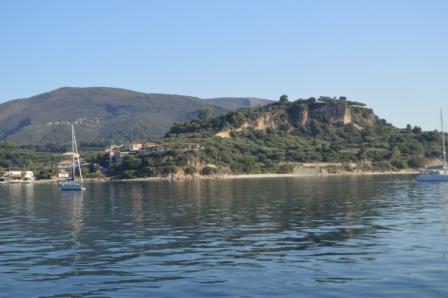
From Katakolon we sailed, at last, across to the south western tip of Zakynthos where on the western edge of a nature reserve for turtles, there was a delightful anchorage at Keri which we enjoyed for a night.
Anchorage at Keri, nature reserve on ZakynthosSailing past Zakynthos town
We had been warned off visiting the main town on the East coast due to crowds and noise, so we gave it a miss and sailed north to the mainland coast above the Gulf of Corinth, finally crossing our transit one year previously and so completing our trip around the Peloponnese. No fizz on board, but a beer was welcome to celebrate with. We did manage the cruising chute on this trip!
George on the helm againZakynthos to Petalis
We discovered a big, largely deserted anchorage, Limin Petalis, on the mainland coast south of Astakos, and ended up spending three happy days on anchor to swim and wait for weather.
Limin Petalis, good remote anchorage
Our planned trip to Astakos was aborted as the strengthening winds were blowing right into the quay and instead we turned around and had a brisk reach across to Vathi on Ithaca.
Here we were suddenly reminded about how crowded the Ionian is. Boats poured into the quay, filled the anchorage and no longer were we alone! The temperatures had been climbing steadily since Katakolon and by the time we reached Vathi being in a breeze was essential to remain below boiling. Fortunately Vathi has a reputation as a windy place and it did not disappoint.
Anchorage at Vathi on Ithaca
Close now to our destination, we tried a couple more anchorages for swim stops in the searing heat, spent a great night on the quay at Sami on Kefalonia before heading up to Ag. Efimia to await the arrival of our (great) nephews Thomas and Ben, who will arrive on Friday, forecast to be the hottest day so far.
On the quay at SamiAcross the harbour at SamiAnchorage outside Sami looking north to EfimiaLooking south to the beachAgaia Efimia, the calm before the afternoon wind
We are planning the next week to take us up to Lefkas and hopefully visit some good places en route in spite of the competitive mooring up we will be forced to join in with!
5 days after Peter’s departure from Kalamata we had a weather window to head out once again. The strong southerlies had abated but they had left an uncomfortable sea which we encountered on our 30 mile trip to Methoni. Every way our course took us, so the moderate wind veered round to head us, we encountered a 120 deg wind shift on the trip! Murphy was out there! We beat some of the way but had to give up and motor more than half the distance to make our port in reasonable time. Anchoring in Methoni became a new experience. The anchor held well but the swell coming into the bay made for rock and roll. We moved further in when space became available which was an improvement.
Back at anchor in Methoni
We made the 7 mile trip round to Pylos ahead of a forecast of more strong winds and had just got tied up alongside a large catamaran in the ‘marina’, when the weather came in. Pylos is situated close to the entrance on the south side of a large inland sea, Navarinon Bay, surrounded by land on 3 sides with a relatively narrow entrance open to the south west which we had expected to afford some shelter from the prevailing north westerlies.
Approaching Navarinon BayEntrance to BayPylos town
Not a bit of it, the bay became a white frothing mass and all day boats were coming in to the ‘marina’ looking for a secure place to tie up. Space was at a premium as the useful, deep but dysfunctional marina is a mess of abandoned ships and boats, many small local boats, tangled moorings and lack of bollards to tie up to! It was so sad to see this safe harbour fail to accommodate the demand simply due to a total lack of organization, and several large boats were forced to go outside and anchor bow into the breakers. Sadly it is very Greek.
We arrived Thursday and knew we would be staying until after the weekend, so we planned time ashore. Our first visit was to the Niokastor Fortress of Pylos. It had been built by the Ottomans in 1573 to control the sea routes from east to west in this part of the Mediterranean. From 1686 the fortress was under Venetian rule, but fortunes and occupants changed regularly until 1830, when the town of Pylos was established outside the fortress walls. The fortress was abandoned and its acropolis used as a prison but reoccupied by the occupying forces during WW11.The fortress was huge, a large enclosure protecting the main core of the settlement and a second hexagonal enclosure around the acropolis. There was lots to see including a well restored church of the Transfiguration of Christ that had originally been built as an Ottoman mosque.
Pylos castle wallsChurch of the transfiguration inside the fortInside the church, very mosque-likeOne of the gated fort entrances
Apart from all this the fortress housed some wonderful museums exhibiting the archaeology of ‘underwater antiquities’ which was a magnificent hands-on display of the spoils from various shipwrecks around the Peloponnese dating from several centuries BC! We learned quickly that the most important commodity being shipped around throughout history from very early beginnings was wine, safely transported in large clay vessels or ‘amorphora’. There were many on display and it was amazing to touch a clay pot from 2nd century BC, complete with a ‘hall mark’, a process of marking invented a long time ago.
Hexagon within fortAmphora from 2nd century BC on display in the hexagonAmazing antiquities reclaimed from shipwrecks off the Peleponnese
One evening we were returning to Déjà Vu after a coffee ashore and in the darkness on the concrete walkway well away from the main part of the marina where we were moored, we came across an unnerving and eerie scenario. A black car had reversed a long way along and was parked hidden, with two men dressed in black standing looking out. We crept passed and climbed aboard Déjà Vu, just a few metres away feeling the need to watch ourselves but more importantly batten down the hatches and turn off the lights! We maintained high security all night and have no idea what, if anything, took place, but our imaginations were working overtime.
We had been told by some locals of recent cases of people smuggling and there were abandoned boats in evidence that reputedly had been impounded by the port police. This was in our minds and it was quite chilling that we decided we did not want to be witnesses to any similar activity.
The next day we decided to take a taxi round the bay to the new town of Yialova. This is a completely new resort town, with a promenade featuring up market shops and restaurants, overlooking a sandy beach. A very pleasant spot. We lucked out and chose what turned out to be the best restaurant for a long lunch with plenty of chilled Rose.
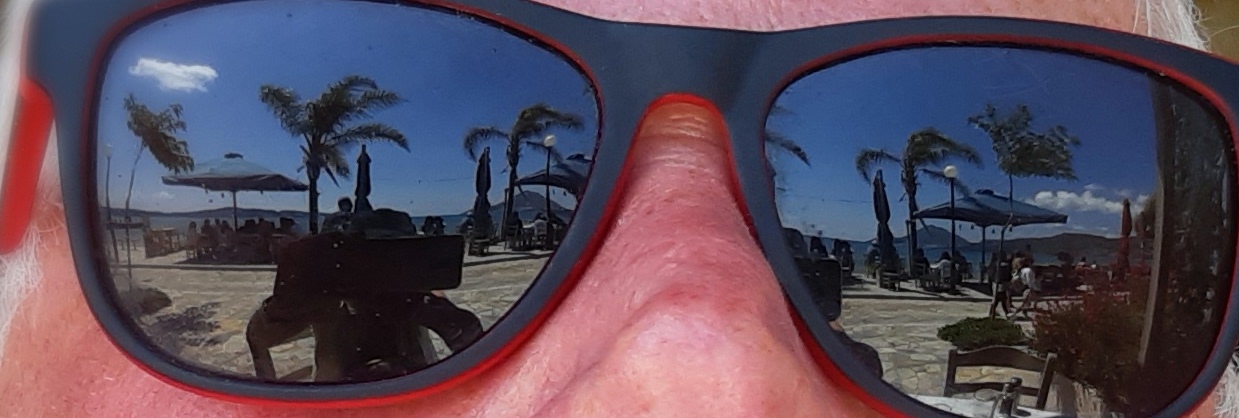
Beach at YialovaReflections at YialovaSandy beaches at the north end of Navarinon Bay, great in settled conditions
Glad to be departing from the marina we sailed around Navarinon bay before heading back to the anchorage at Methoni for a couple of nights. We were able to get water ashore which enabled a few more showers on board but having lugged 50 litres back to the boat we were conscious of the weight that the 450 litres in our tanks represents . We made a day sail of visiting Port Longos on the adjacent island to the south, just an anchorage with nothing but nature for company, before heading up to visit Finakounda to the north. We anchored offshore in a bouncy sea keenly expecting it all to go calm once the afternoon sea breeze died down, which true to form it did. Finakounda is a pretty seaside resort, quite touristy and noisy with music late at night, but it did have good beaches. It is unfortunately not very sheltered and we decided it was not the place to be for the next night with stronger winds once again in the forecast.
Finakounda from the anchorage
We backtracked to the safe anchorage at Methoni simply so that we could return to a very good restaurant that we had visited with Peter on his birthday a few weeks earlier!
On the moveLight wind sailing for a change!
With calm winds at last on the horizon we set off East and had an overnight stop in South Koroni before heading further east to the bay of Limeni. Limeni has eluded us many times as it is open to the prevailing westerly winds and therefore not a great place to go in fresh conditions. We had a calm and quiet visit which was very pleasant and as, at last, the air and sea temperature were on the rise, we enjoyed plenty of swimming. The air temperature went from 22 Celsius to 32 Celsius in one day and is now set well into the 30’s for the foreseeable future. It is very hot but fortunately the sea temperature is now an enjoyable 22 degrees. Being on the Mani peninsular there were lots of fascinating examples in the bay of the very particular Maniote architecture, mostly modern builds in the picture we took, but as you can see quite Moorish and very un-Greek in style.
Eastern end of Limeni bayThe beach at the east end of the bayThe unusual architecture of the Mane peninsularBehind the quay at the east end of Limeni BayNewly built houseLovely stonework
From Limeni we made the final trek back to Kalamata as we have a flight booked home in a couple of days. It is sweltering hot now and it is not pleasant being in a Marina, but the laundry will get done and the boat will get a spring clean. We have refuelled and will revittal when we return in just about a week to start the next phase of our journey which will be to complete our circuit around the Peleponnese.
It is Monday 27th May and a good day to update the blog because as I write it is raining and not a day for sailing. We have done the boat chores and the shopping so will be off as soon as this depression passes through, hopefully tomorrow.
Filling in some detail for the last couple of weeks with friend Peter on board, look what he came back with when we sent him to the bakery for the morning bread! We did try them, but they tasted much as they look and he was banned from making a repeat purchase.
What does this look like to you? Perhaps it is the colour, now banned!
Together we explored old town Kalamata, visited the underwhelming castle and what is left of the old buildings and streets to the north of the town but were disappointed not to find the museums open.
Cathedral chuch in old town KalamataAn early churchOld town streetGood lunch in old town
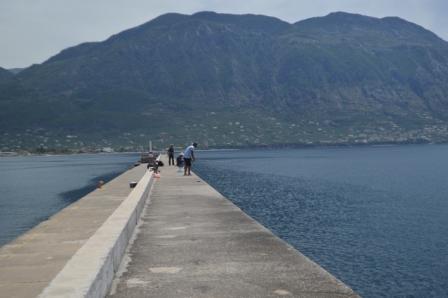
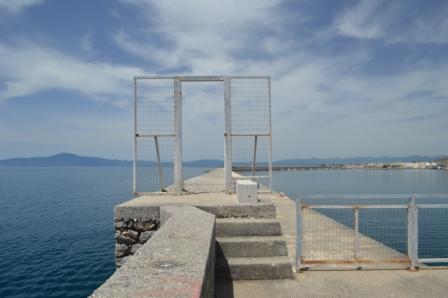
We walked the harbour pier which was an impressive construction about a mile long protecting the town harbour quays. It is hard to imagine that in the southerly winter storms these walls are under attack and are often breached by the pounding seas.
Fisherman on the harbour wall in KalamataFrom the lighthouse end of the harbour wall looking back
We had a good sail south to Methoni, a sheltered bay on the south western tip of the Peloponnese, where we anchored safely sheltered from the strong north westerly winds.
Good sheltered anchorage at Methoni
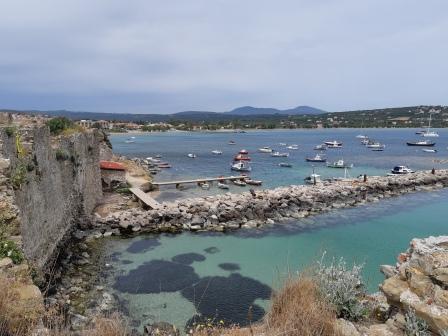
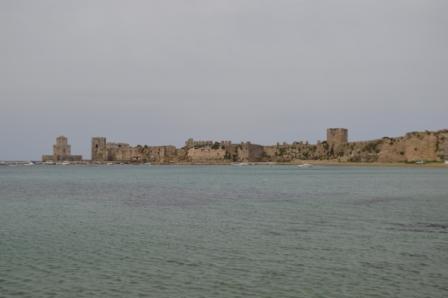
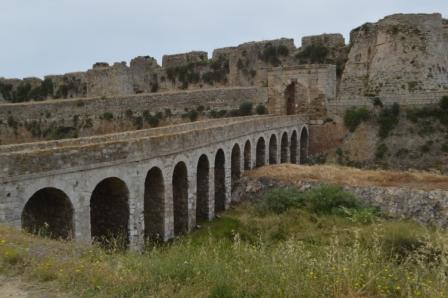
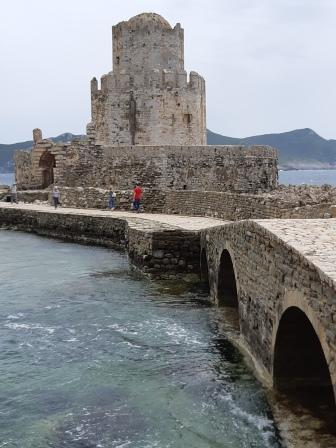
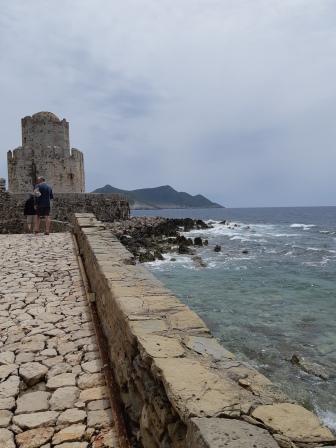
Methoni was very interesting with the ruins of an impressive Venetian fort and a Turkish tower straddling the north south peninsular below the town. The fort guarded the shipping route around the Peleponnese. When the Turks captured it and it is told that Cervantes was a prisoner here and the tale in his Don Quixote of the captive may well relate his experience as a Turkish prisoner.
Extent of fort as seen from anchorageApproaching fort on footClose up to the Turkish towerVenetian archWest flank of fortHuge expanse within the fortifications housed the town in earlier times.Windswept on the west side
We enjoyed exploring the whole area for the princely sum of 1 euro each for OAPs!
We celebrated Peter’s birthday in Methoni at a splendid restaurant and Peter manned up to do some serious swimming, perhaps to burn off the indulgences of avocado on toast for breakfast and lamb kleftiko for supper! Credit is also due to Nigel though who swam with him for a few minutes!
Happy Birthday Peter!Two kinds of swimmers!
We had a brisk sail back to Kalamata for Peter to make his flight home.
Back to Kalamata
It had been disappointing that we did not make the trip to Crete and back, but it was not meant to be. It is clear that Kalamata is a transit stop and not good as a cruising base due to the dominant strong wind patterns in the area. This basic problem has certainly been exacerbated by the truly strange weather we have experienced. It has been much colder and cloudier than normal with frequent low pressure systems passing through giving strong winds and rain. We thought that last year was unusual but this year is shaping up to be worse; could this be the reality of a changing climate?
We arrived to find the boat in a sorry state after two weeks of heavy rain that dumped half of the Sahara desert onto our decks and cover. Our first job was to hose the boat down which was an immediate improvement but the red dust had penetrated everything and it took several washes to rid Deja Vu of all the dirt. Next came the antifouling which was the usual messy task of rubbing down, masking and painting. With that finished we booked our launch for Thursday 9th May.
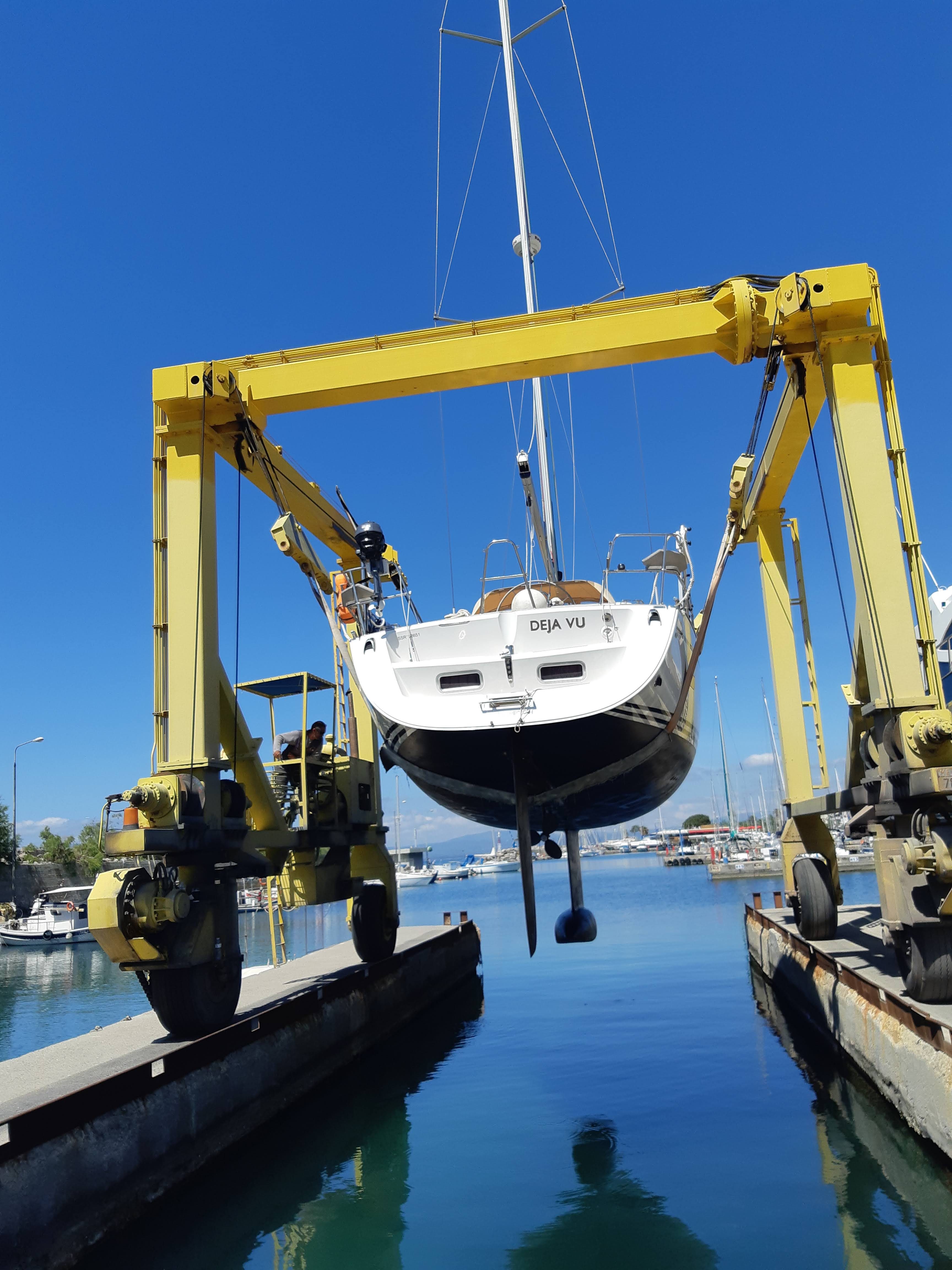
Tractor arrives to take Deja VuGently does it!
Much happier in the water we continued the cleaning and maintenance jobs, polishing the topsides and all the chrome. Déjà vu was sparkling!
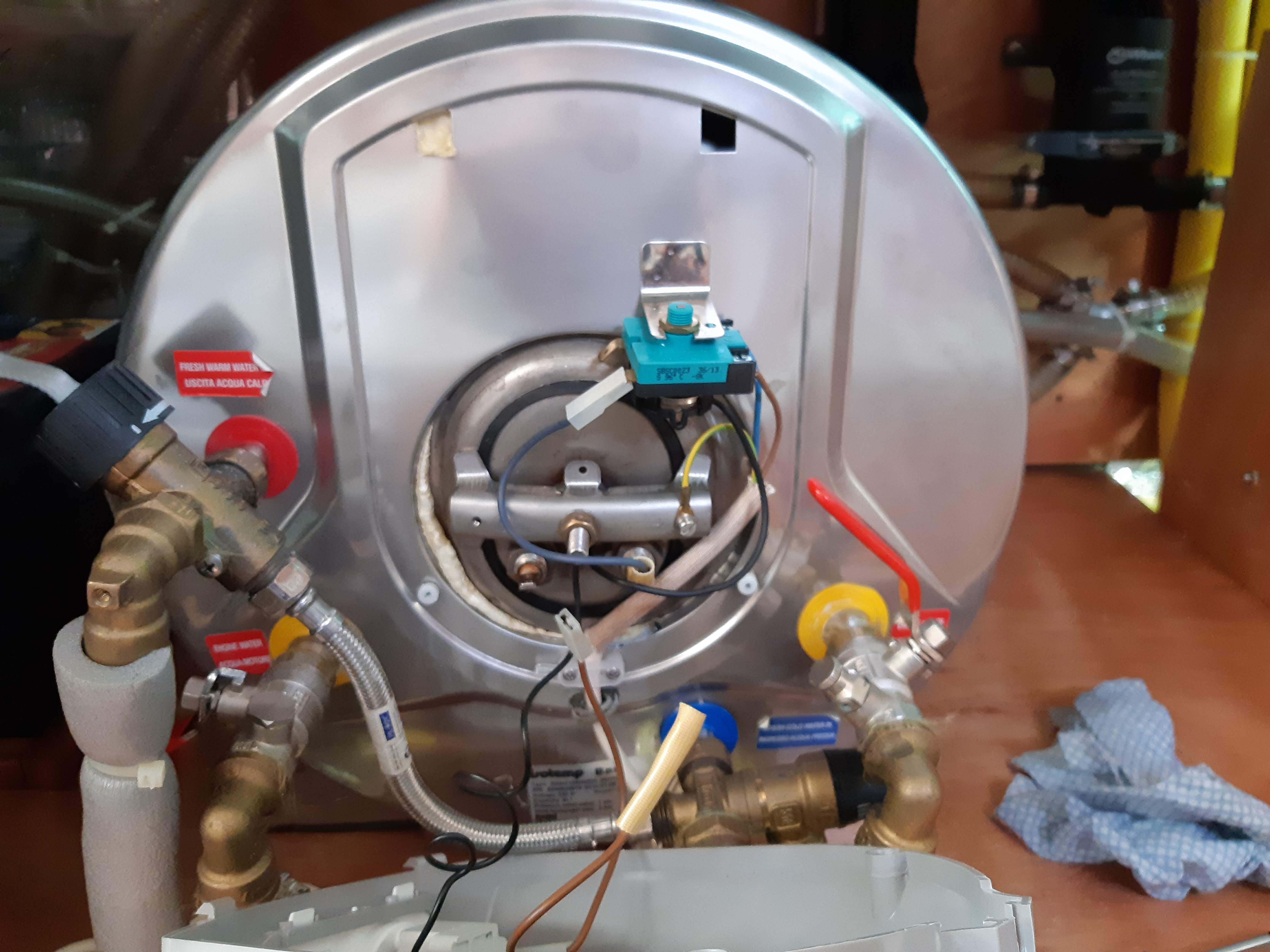
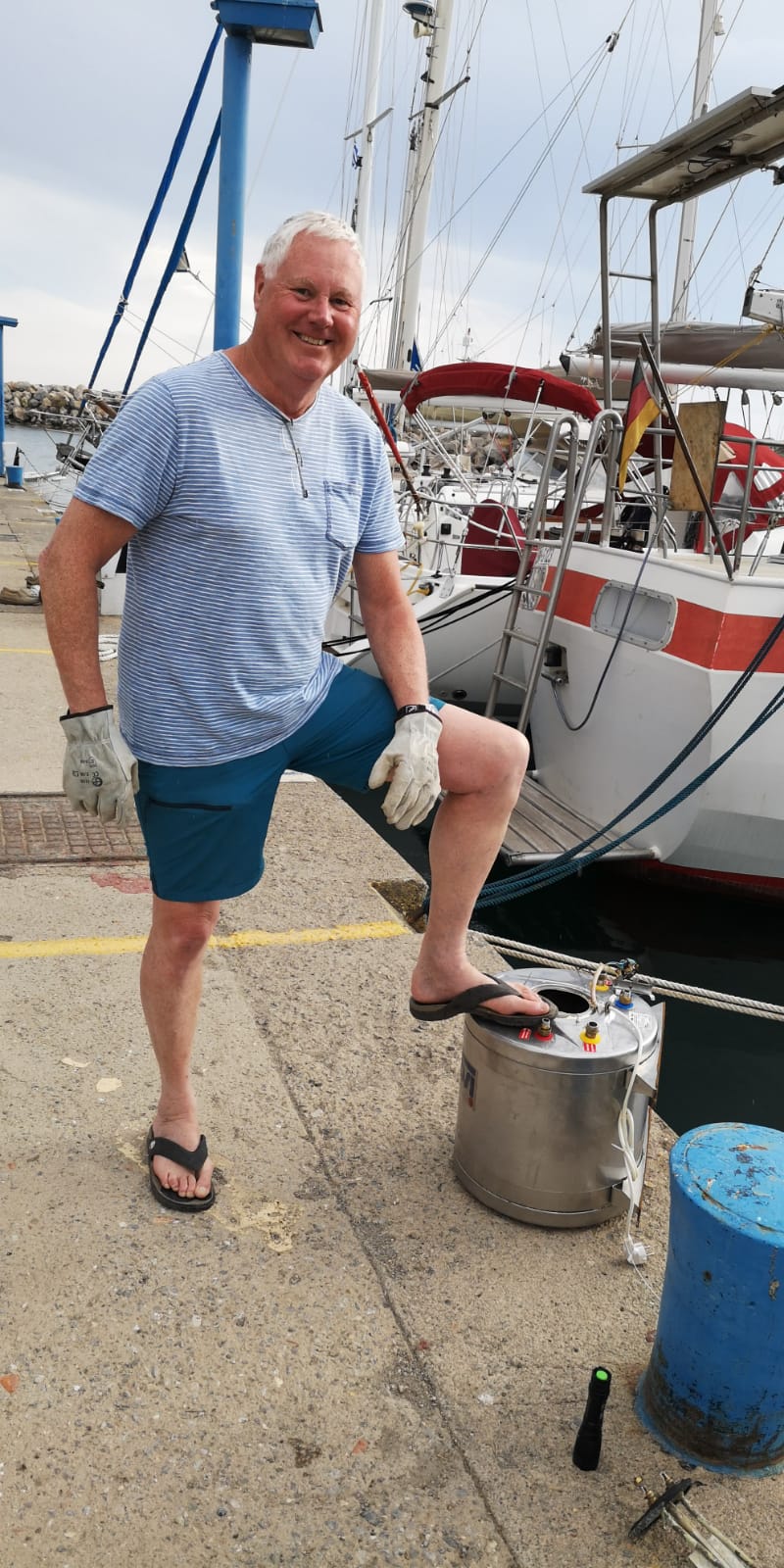
As we filled the water system on board, delighting in the luxury of running water, hot included, we discovered to our dismay there was a leak. Nigel traced it quickly to the hot water boiler which, on close inspection, was condemned. It must have frozen during the winter and split a seam.
The leaking boiler!
We discovered that it was a problem to get a replacement in Greece and a speedy review of alternative manufacturer’s boilers all of which were the wrong size, we concluded we had a problem. It was Thursday and with our friend Peter due from the UK on Sunday, we knew we had an opportunity to bring parts from the UK as long as we acted immediately. Luck was on our side.
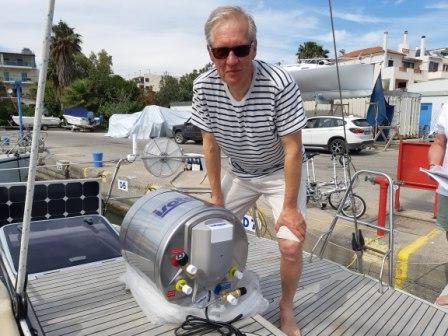
What a blessing the internet and the mobile phone proved to be. We traced a replacement boiler in Doncaster of all places and organized its urgent dispatch to Peter’s house in Farnham. Fortunately it arrived on Saturday, Peter had established he could get it through airport security and we were thrilled we had a plan. In the meantime Nigel had bypassed the boiler so that we could at least have cold running water, but as soon as this was done we discovered the second leak in a fitting near the pump, that looked like more frost damage. Once again the local chandler did not have the spare parts we needed to do a repair, so more urgent messages to Peter to trawl the local plumber’s merchants.
Peter arrived late afternoon on Sunday 12th May bearing vital gifts to repair the boat!
Peter brings the new boilerOut with the old! (tank)
Nigel set to on Monday and did some ambitious plumbing repairs with Peter assisting and with a little advice and assistance from the very helpful, but overworked, local Greek engineer, John.
By Tuesday we had the boat back in working order.
We had planned to sail to Crete but the weather was not in our favour. Strong winds south of Kalamata have persisted for the last week and look to remain for the foreseeable future. This has curtailed our sailing as there are few safe places to go to that are not in the teeth of the weather.
We managed a couple of day sails to Koroni and to Petalidhion which were good but cloudy and cool!
To sea at lastSnow on the mountainsEveryone’s happyNigel and Peter in KoroniNigel and Mo, KoroniArtistic in Koroni
Despite the cool conditions and sea temperature well below normal Peter donned his newly acquired wet suit and took to the water briefly with a quick swim to look at the anchor. He even repeated the process a couple of days later claiming it to be a good experience through gritted teeth.
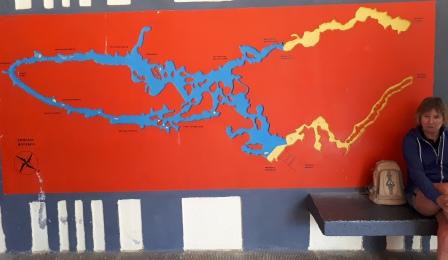
Thursday 16th we hired a car to visit the stunning caves at Diros, a 90km drive on very winding roads south of Kalamata. The tour involved a punt with 6 or 7 on board, paddled by a guide through a maze of dimly lit underground passages which opened into stunning cathedral style caves boasting magnificent stalactites and stalagmites in all sorts of colours. Some of the canals were very narrow and low and slightly testing for the claustrophobe, but the experience was well worth it.
Routemap of underground cave systemPunt through Diros cavesUnderground at DirosEerie in placesImpressive caves at Diros
We drove back to Kalamata through Sparta and over the mountains which we did last year, and repeated to show Peter the stunning scenery.
Sparta to Kalamata mountain roadOver the mountains, note the weather!
We have been enjoying Peter’s good company and have cooked on board, enjoyed meals in local restaurants, been walking and cycling. However the frustration of not sailing where we want to go is wearing us down! The forecast is still against us, so we will have to wait and see what happens next.
It is April 2nd and plans are in place for our departure to Kalamata on May 7th. We are off on a Safety at sea course mid April and a First Aid refresher course early May.
We made a trip out to Deja Vu in early March and took with us a new BBQ (essential supplies of course) and several important items from a variety of chandlers. Our engine spares have been replenished! We managed a supermarket sweep whilst we had a hire car so Deja Vu is carrying plenty of food and supplies ready for the season ahead.
We are enjoying a warm start to Spring and England is looking lovely with blossoms, spring flowers and early shrubs blooming. It is just such a pity the political chaos in the country is making it an ugly place to be! Perhaps a few weeks cruising in European waters will be just the tonic and escape we need from all the madness back home. We are hoping that somehow common sense will prevail and we will soon have a workable outcome to the EU debacle.
Paul and Jane’s visit to Deja Vu had had to be rescheduled due to a mix up on dates in the earlier planning phase of this trip, so we were glad to be able to welcome them in Kalamata on Thursday July 5th although had no idea what cruising opportunities lay ahead.
Nigel and Mo with new crew Jane in marina
They are both very keen sailors and we went out on daily adventures to discover the good and bad local anchorages, returning to the Marina most nights for shelter. The wind forecast was for very strong winds around the south western cape so our cruising range was limited by this We had some good sailing and did manage to visit several really nice anchorages.
Overnight anchorage at Koroni, south bayFrom the church above KoroniKardamila lunchtime anchorage
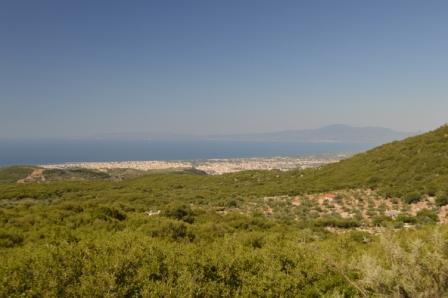
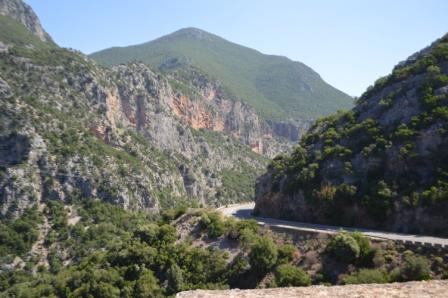
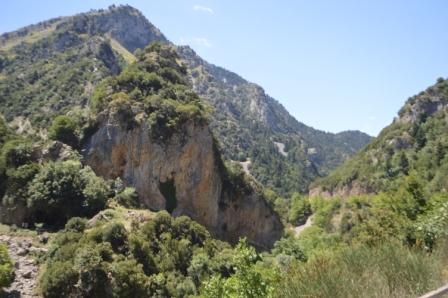
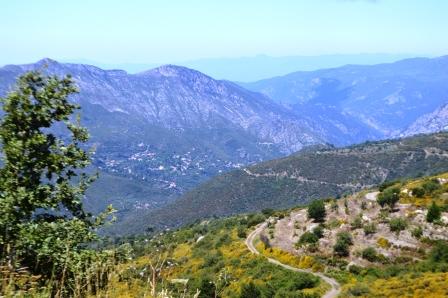
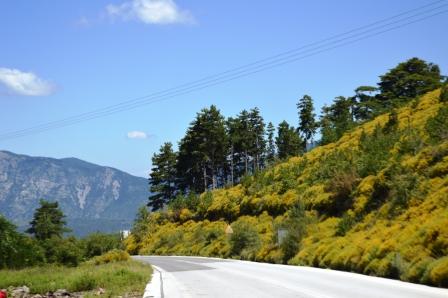
We rented a car and ventured inland for a day to explore the hinterland and were treated to some amazing scenery on the road to Sparta. We took a winding route up into the mountains with plenty of hairpin bends to negotiate and stunning scenery to enjoy. We diverted down even smaller roads to find a monastery which we never found, but we did stumble on an amazingly fertile valley with quite a large population buried away in the middle of the mountains. Goodness know what they all did there.
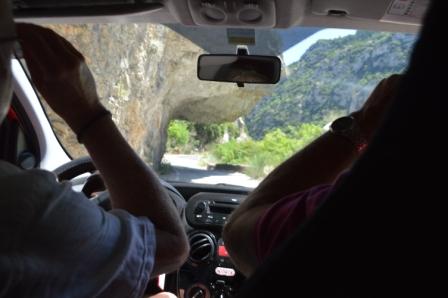
Enroute to Sparta looking back to KalamataScenery kept getting betterand betterWinding up to almost alpine elevationsStunning flowers from gorse to orchidsUnconventional tunnels
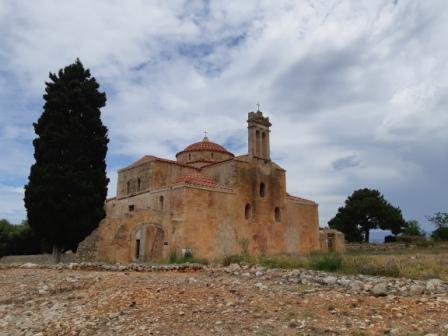
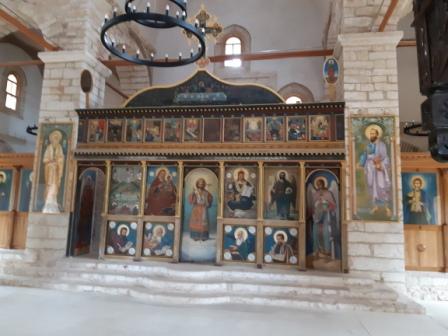
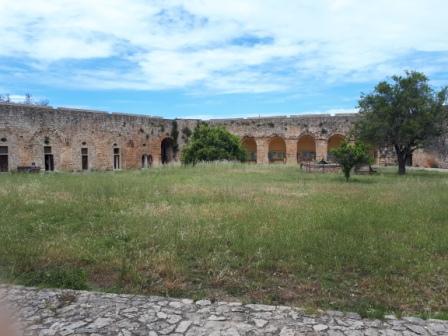
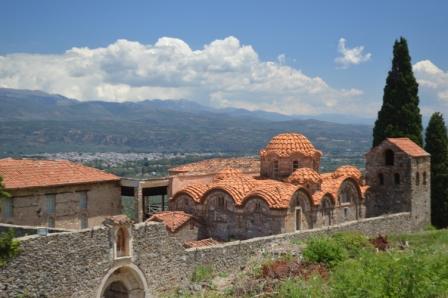
We came across the amazing site at Mystras, a naturally fortified hill town which played an important role in the history of the Byzantine Empire during its final centuries until it fell to the Turks in 1460.
Byzantine church
It was from 1262 that the Byzantines became the rulers of Mystras which was a brilliant period for this medieval fortress-state. The hill filled with houses, mansions and palaces, churches and fortified monasteries and the densely populated city had two enclosure walls. After the mid 14th century the imperial family of Constantinople assumed rule and the Despotate flourished and developed into an important cultural centre closely connected with Constantinople. Here the arts and letters were cultivated by important artists and men of intellect who would play a significant role in the growth of humanistic studies and the evolution of artistic trends in 15th century Europe.
Across the siteByzantine detailFresco detailCloistersMystras was well worth a visit, 6 euro for OAPs!
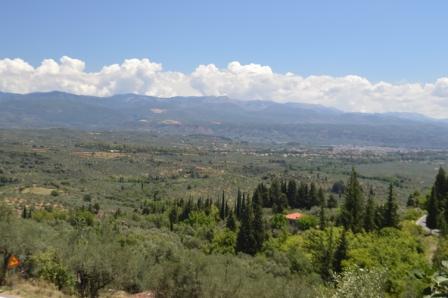
The mountains we drove over gave way to a large interior plain, quite fertile with plenty of olive groves and citrus orchards. Sparta was nestled in this wide plain.
Inland plain
We did get to Sparta which was a disappointingly communistic and ugly city, rebuilt after earlier earthquakes. The ancient history associated with Sparta was poorly remembered in a small park showing off the best of the remains.
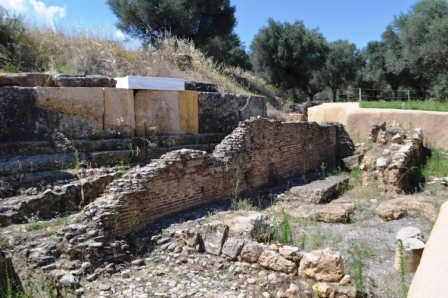
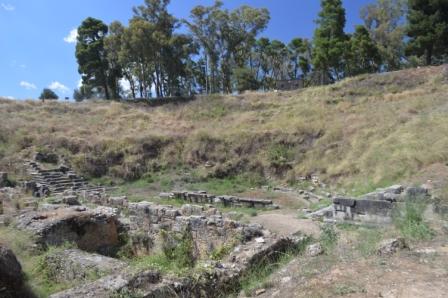
Remains of old SpartaRemains of the ampthitheatreFrom the old city looking across to the new
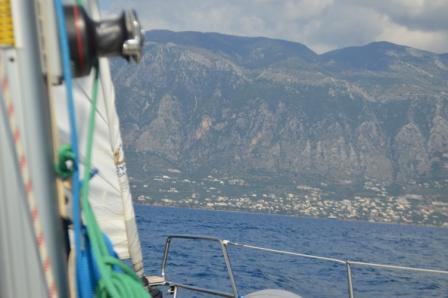
Back on the boat the next day we had a most enjoyable sail across the top of the gulf to anchor off the town of Petalidihion. On the way the wind was from the north on our beam, on the way back it was from the south, on our beam until we were a couple of miles away from the marina, when it died altogether for a while. The next thing we knew was we were in a 25 knot northerly! Such is the fickle nature of the winds in this part of the world .
PetalidhionNorth east corner of the GulfSuperb views from the Marina
Thursday 12th July came around all too quickly and Paul and Jane headed off to the airport to return home. We were trying to negotiate a satisfactory sea berth for our winter storage which rapidly turned into an offer to be lifted out to over winter on shore. So on this our penultimate day, we are cleaning and packing up to bring the 2018 sailing season to a rather early close.
Kalamata is an interesting place, the views of the mountains around are stunning and we know there are many more places to explore inland as well as west when we get back out to sea. Plenty to look forward to in 2019.
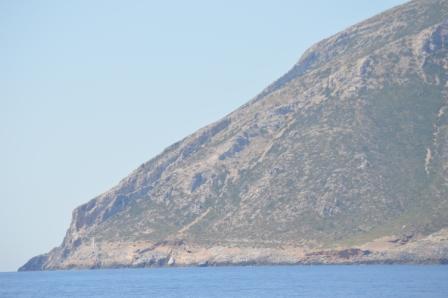
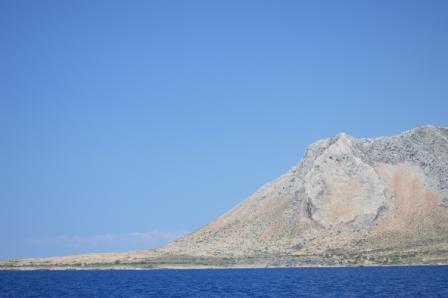
Cape Maleas, the second most southerly point in Europe, has a fearsome reputation and at times lives up to it according not only to the author of our pilot guide, Rod Heikell, but also the present day locals and the Ancient Greeks.
Heading towards Cape Maleas, remote isolated settlements seem quite cut offThe bottom in sightA menacing dragon asleep or what?!Round the bottom heading across to the sleeping mammoth
Having waited for a week in Momenvasia for the very strong winds to abate we actually set off in very light winds and ended up motoring towards the cape and around the bottom. It was quite an awesome trip with huge rock faces towering above us and an uncanny atmosphere of silence as we rounded the bottom. The winds here are simply unpredictable and gusts can be 50 or 60 knots in a 20 knot ambient wind. In the benign conditions we encountered we saw barely 15knots which was perfectly fine by us!
We had seen pictures of the idyllic anchorages off the island of Elafonisos and so made a bee line for them. The two open to the south were untenable with the residual swell from the week long gales so we opted for the east facing bay of Levki for a pleasant overnight stay.
Peaceful anchorage for the night
With limited time before we needed to be in Kalamata to meet Paul and Jane, we pressed on to the second limb of the southern Peleponnese and anchored in the small bay of Porto Kayio. It became very crowded here and we had boats all around us; not good for Deja Vu who wanders annoyingly at anchor in a fresh breeze. We did get ashore to a taverna for a not very good fish supper but spent quite a bit of the night on anchor watch until the fresh wind eventually died down soon after midnight.
Porto Kayio
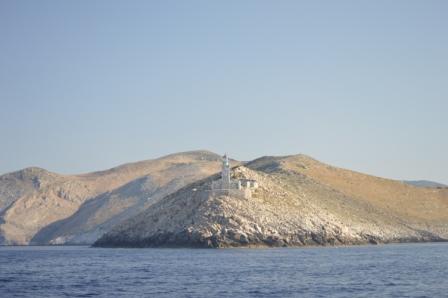
The second cape of Matapan complete with lighthouse has been described as ‘the entrance to the underworld’ but it is far less threatening than cape Maleas. By this time though we had seen a lot of the rugged outline of the Peloponnese and it is a formidable tough and inhospitable landscape which is awesome and worthy of respect.
Approaching cape MatapanCape MatapanThe entrance to the Underworld?Harsh geology after cape Matapan
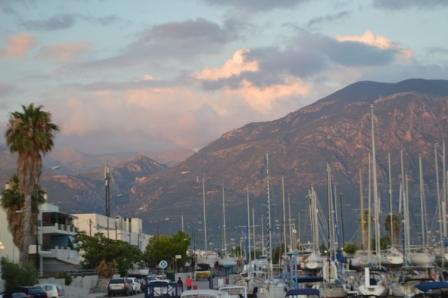
After a long day turning north into the western most gulf we made the approach to Kalamata. We had no pre-conceived ideas of the area and were a bit surprised just how large the town of Kalamata seemed to be. It flanked the north east corner of the Gulf and spread some distance inland. It did not seem that the Marina staff were expecting our arrival in spite of our careful booking in, but we were ushered into a welcome berth on Wednesday July 4th, well in time to be ready for our next guests to arrive on Thursday 5th.
We have been storm bound here for a week and seen 360 degree lightning, torrential rain and, for days after the storm, gale force winds. In spite of the gloom there is quite a bit of good news that is keeping us sane. Firstly we are safely tucked into the harbour and securely tied up on the harbour wall, secondly we have discovered that Monemvasia is an absolute jewel in the crown of historic sites in Greece, little talked about, but amazing to see and visit and last, but by no means least, we are not alone. Plenty of other European sailors and there are also resident turtles in the harbour which are easy to spot most days.
Stormy skiesAcross the harbourMidday!Local resident
We have met some delightful fellow sailors waiting, like us, for better conditions to go in their various directions. We have mentioned the German couple Eva and Frank, who, apparently, with all the time in the world, are setting off to explore new places, probably Northern Greece. We have also met Ian and Sarah, from Yorkshire, on yacht Linea who are wanting to go west to Milos and then on to Kos, collecting daughters on various islands en route. They have a bit of a deadline, but as I write it is blowing a westerly Force 7, the sea is rough and we have heard that yesterday two fishermen were lost at sea off the Crete coast, not so far from here, so suddenly deadlines pale into insignificance. We and various other boats want to go south and then east. It is looking like we all get a weather window at the weekend.
New friends in Monemvasia
We have enjoyed much camaraderie and bon viveur facilitated with Ian’s excellent Italian wine and the local butcher’s homemade sausages, which were BBQ’d on the quayside last night as the wind howled. We have met a Polish crew, some French and Dutch sailors too, all very friendly. We have been surprised at just how many live-aboards we have met. Most of them head to southern Sicily to winter where, by all accounts, there are some lively communities. Lovely though they all are, we are not tempted!
North quay untenable in strong north or westerly windsBest shelter in main harbour where we were on the quayLooking back from a walk inland where it was sheltered!
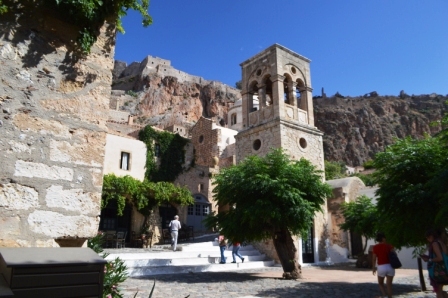
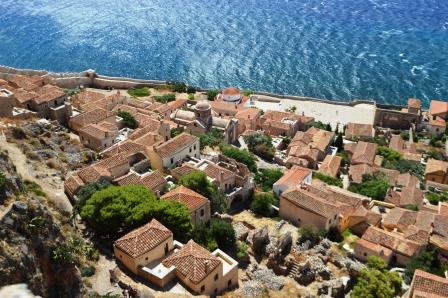
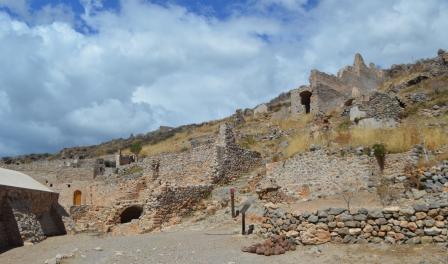
Thursday we visited the old town of Monemvasia. A short walk from the boat took us to the causeway where we caught the bus across to the huge rock that is Monemvasia. The first settlement here was in the 6th century and over the intervening years it has been successively and repeatedly occupied by Venetians, Ottomans and finally Greeks, fighting alternately for possession. It is a stunning fortification, seemingly impenetrable, with a lifting bridge on the early causeway and rugged rocks meeting the sea all around the mountainous outcrop. The town is walled with tunnels through to tiny streets, home to minute houses and a disproportionate number of churches which have been either Christian or Moslem depending on the resident occupants! The main street has a few cafes, shops and tiny hotels, all very romantic as long as you are not a claustrophobe! We climbed almost to the top of the rock, arriving at the upper citadel that was in ruins but in the process of initial restoration. From here we had a fantastic view over the lower citadel and the surrounding region, including a very angry sea. This reminded us that we had been long away from the boat and we returned to find it battered by gusty winds but otherwise fine.
The rock that is Momenvasia, the town clings to the seaward sideOld town Monemvasia entrancePart of the fortificationsTiny streetsWere the early occupants midgets?Centre of lower townFrom upper town looking down6th century ruins above upper town
The relentless pounding, howling and ferocity of the wind is truly wearing and the nights afford no place to hide either, as it has not been uncommon for 40knot winds to fall off the mountains and hit the harbour just for good measure, usually around 1 or 2am. Everyone is up fending their boats, some boats have slipped anchor, many anchors have got trapped, boats have got stuck and spun around in the wind threatening everyone else, all in all general mayhem. In the middle of the black night this is not fun but once again everyone pitches in to help everyone else and somehow all have remained intact.
Sunday July 1st looks like our escape day. The winds are abating. We are just hoping the sea state will not be too horrendous for our transit around the notorious Cape Meleas which will be the subject of our next blog.

















































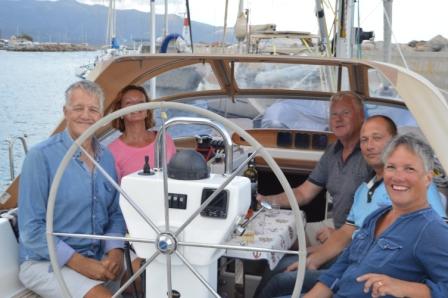


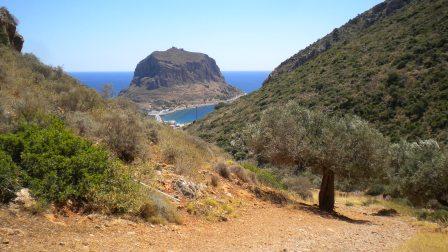
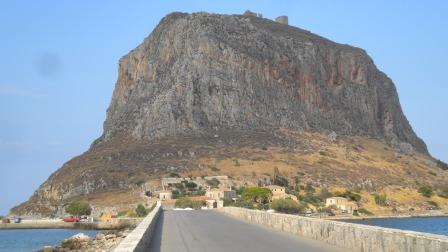


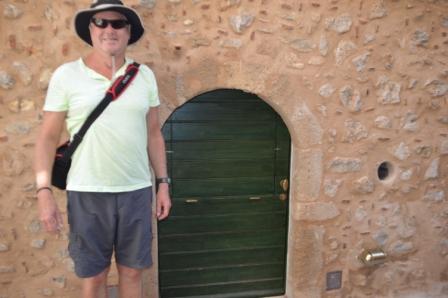
 Deja Vu
You must be logged in to post a comment.