Montenegro is a small, rugged and beautiful country. The country covers just less that 14,000 square kilometres, has 293 km of coastline, 70 mountain peaks 2000m above sea level. Made up mostly of hills and mountains, it is dramatic, unforgiving terrain that supports a population of about 600,000. In the north of Montenegro, the River Tara runs in a canyon that is the deepest in Europe and claims to be second deepest in the world after the Colorado Canyon. It is 78 km long and 1300 m deep. In the south of Montenegro, on the coast, the famous Mediterranean fjord that is the Gulf of Kotor is a stunning sight which cannot fail to impress.

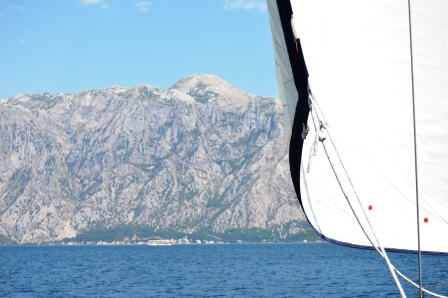
Montenegro claims to be the first and the only ‘ecological’ state in the world, receiving this acclaim in 1991. We have read that out of 2800 plant species in Montenegro, 22 are unique and cannot be found anywhere else in the world and similarly many unique species of eel and carp can be found in the inland lakes.
One has to have a permit to cruise around the Montenegrin coast and you can either have one valid for a week or a month which we ended up with as a week was not long enough. We will have spent about 3 weeks here. We checked into the port of Bar on 24th July and stayed a couple of days then moved on up to Budva, party capital of the coast. The old town is exquisitely beautiful as we discovered last year, and the rest of the town is lively and very full of holidaymakers from Russia and many European countries. Beach space was at a premium so the boat came into its own to go and anchor off the shore to ensure essential swimming for maintaining a cool body temperature. It was 30 degrees most days. The problem with Budva was incessant music. During the day there is a relentless diet of Europop from the beach bars and just when folk like us are thinking of going to bed the discos start up and bash out relentless head banging noise that thankfully stopped like a bad headache, between 1am and 1.30am. We became more nocturnal in our habits and stayed up until 1am most nights, along with the rest of the population. Bars never seemed to close, ice cream was still being sold and it seemed it was only us beginning to tire. Must be something to do with our age! The big advantage of this need to stay up late was the fact it enabled Mo to phone New Zealand after midnight which was an acceptable morning time there and Mo managed some good calls to her Mum, still in hospital. We found the Guinness Bar had the best wi fi connection, except on the day that Montenegro was playing Italy in a water polo match. We had not seen such fervour amongst the spectators since football in the UK!
We rented a car for a day to explore beyond the coast and, in spite of the lunatic Montenegrin drivers, whose frustration at driving on very winding mountain roads is vented by random overtaking attempts on blind bends, we had a great day.
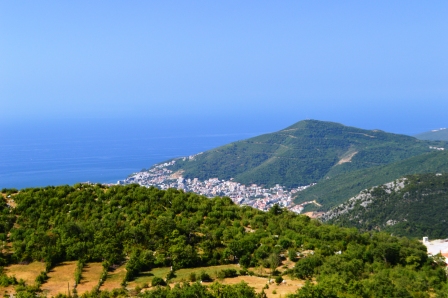
We visited the city of Cetinje, the old capital famous for never having been conquered by the Turks, despite several attempts! A very religious city, the centrepiece is a fine monastery with chapels claiming to house many important religious artefacts, including a part of Christ’s cross. Unfortunately we could not find this!

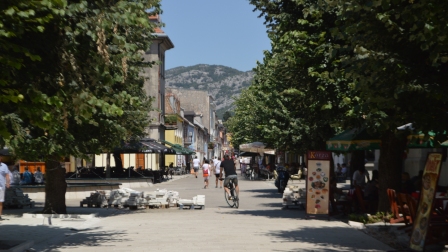
We drove past the more modern capital city, Podgorica, apparently the hottest capital in Europe, regularly clocking over 40 degrees, and we went north on the main road to visit the famous Ostrog Monastery.
We found the Monastery high up the mountain side, 8 miles off the main road, and accessible only by the most diabolical winding road that snaked up the mountain with more hair pin bends than we have ever seen before, pot holed with no crash barriers, few passing places with cars and coaches to negotiate in both directions! We were grateful to arrive unscathed if not very hot and weary!
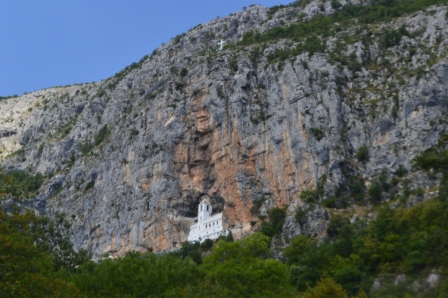

Even though we drove as far as we could, we still had a load of steps to negotiate in the searing heat before finally arriving at the monastery which had been built in this inhospitable place in 1650. We joined a queue which we thought was the entrance to go in, but as we ducked our heads and entered the cool mountain chamber, we realised it was for the privilege of kissing the rosary held by the Orthodox priest and receiving either a blessing or some absolution. We offered our respects and retreated to explore the rest of the Monastery open for us to view.
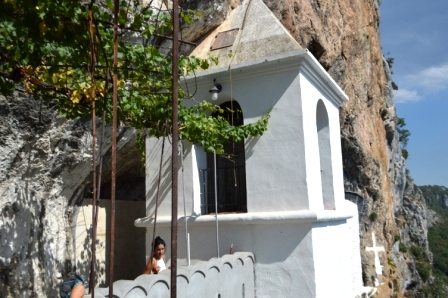

We chose the ‘new road’ as an alternative to return south to Podgorica, and what a blessing as it was tarmaced and had two clearly marked lanes!
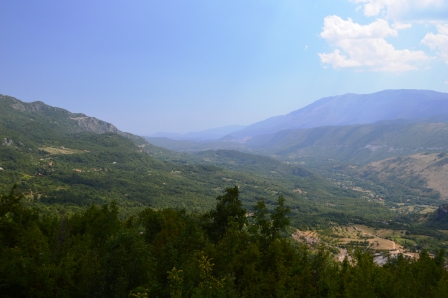
Our day was running out but we made it to the head of the huge inland Skadar Lake, the largest lake in the Balkans with over 40 islands, now a national park, two thirds of which belongs to Montenegro, one third to Albania. The scenery reminded us both of New Zealand, a long lake flanked by high olive green hills dropping down into glass blue water.
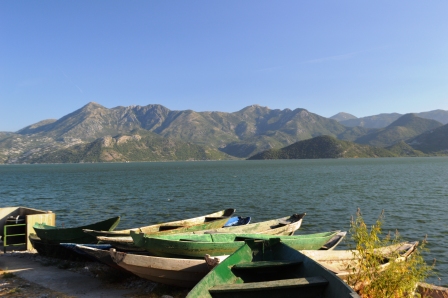

We drove a little way around its edge on a highly dodgy road passing local vineyards and were tempted in to sample some local wine. Very abstemiously we only bought one bottle of red at a vastly inflated price!
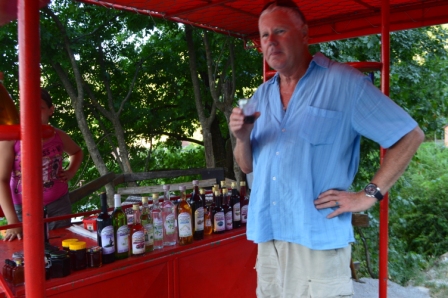
This was a beautiful area and we could have spent more time exploring, even taking a boat trip, but our time was up and we had to return the car to Budva.
Back on the boat, we noticed a sudden pressure drop on our barometer on board Deja Vu and it was not long before a full blown gale ensued whilst we were tied up in the Marina at Budva. We reinforced lines, positioned many more fenders, lashed the dinghy more securely and had to eat down below as the glasses were being blown over and Mo’s lettuce was taking flight! It was a rough night as the wind raged, peaking at 45 knots. We had to stay on board and listen to the wind and the disco music. We were not sure which was worse!
From Budva we sailed north to Bigova, a charming fishing village, calm and quiet after the noise of Budva. We spent two nights on a buoy here, exploring in the dinghy and swimming a lot.
Now we have arrived in the beautiful Gulf of Kotor which is well documented from our visit here in 2012. We will spend a few more days before leaving Montenegro and going back into Croatia. We are meeting Faye and Guy on 17th August in Dubrovnik and they will be sailing north with us towards our home port. We plan to drop them off in or around Split from where they will get their flight home.
 Deja Vu
You must be logged in to post a comment.